
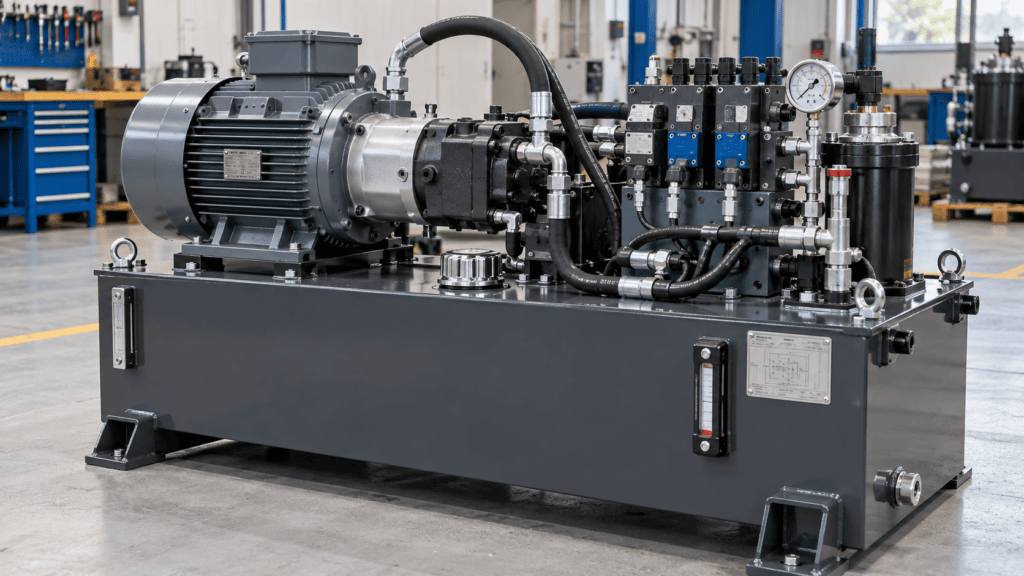
If you’re planning a custom hydraulic power unit, there are a few particulars you will likely need before securing an accurate quote. Details like pressure, flow, voltage, cylinder size, and duty cycle are necessary for suppliers to size a system correctly the first time. Join us as we explore some of the questions you need to answer before designing a custom hydraulic power unit.
What Does the Hydraulic Power Unit Need to Do?
Trying to build a power unit without defining what it will be used for is a recipe for disaster. Before you start compiling a list of components, think about what the application is. Explain what you’re trying to move, how far it needs to go, and how fast it needs to get there. If you’re operating a cylinder, your supplier will need the bore, rod diameter, and stroke when you have them.
Though you don’t need to calculate the required pump size (your supplier will do that), giving as much information as you can about what the equipment needs to be able to do will help the supplier find the right hydraulic components.
What Pressure and Flow Does the System Require?
Pressure and flow mean two different things in a hydraulic system. Pressure relates to the force available to do the work, whereas flow impacts how quickly an actuator moves. A power unit must provide enough of both for the application without simply being oversized.
If you are replacing an existing power unit, look for a nameplate or documentation that provides the pressure and flow specifications. For a new design, determine the load, cylinder dimensions, and desired cycle time. These details help suppliers calculate what the system needs in terms of flow and pressure.
How Often Will the Power Unit Run?
Duty cycle can easily be overlooked when you’re focused on pressure and flow, but it has a huge impact on how a unit is designed. Discuss with your supplier how often the unit will operate, under what conditions, and how long each cycle lasts. This information informs motor selection and overall configuration.
What Power Source and Controls are Available?
For a DC hydraulic power unit, one of the first things to confirm is whether the equipment provides 12V or 24V power. The supplier will also need to understand how you want the hydraulic functions controlled, such as remote control, solenoid-operated valves, limit switches, or controls that integrate into the rest of the machine. You don’t need to finalize the electrical and hydraulic scheme before making this kind of decision, but you do need to be able to specify what the operator or machine needs to be able to do.
How Much Space Do You Have?
Building the perfect hydraulic power unit won’t do you any good if it doesn’t fit in the space you have. Measure the available space and determine how the unit will be mounted. Photos can be especially helpful for suppliers to understand your space and the operating environment.
Providing these constraints early gives the supplier a chance to account for them while choosing the reservoir, motor, pump, and valves.
What Should You Send With a Custom Power Unit Quote Request?
Though you don’t need to have the whole hydraulic schematic figured out in the first conversation, it is important to bring whatever information you do have to your supplier. This may include:
- Load and required movement
- Cylinder bore, rod diameter, and stroke
- Desired operating speed or cycle time
- Available voltage
- Expected duty cycle
- Space and mounting limitations
- Control requirements
- Photos or drawings
Even if you don’t have an answer to every question, any information is useful. The goal is to give your supplier enough of the application information to start asking the right questions.
Planning a Custom Hydraulic Power Unit?
If a new equipment project is on the horizon, getting the application details together early can make quoting and planning much easier. Dewald Fluid Power specs and builds custom DC hydraulic power units around the cylinder, load, duty cycle, available space, and 12V or 24V electrical systems. Send us what you have, even if it’s just a sketch and a few specifications. Call Dewald, request a quote, or stop by the Mishawaka counter, and we’ll help you turn those requirements into the right power unit.