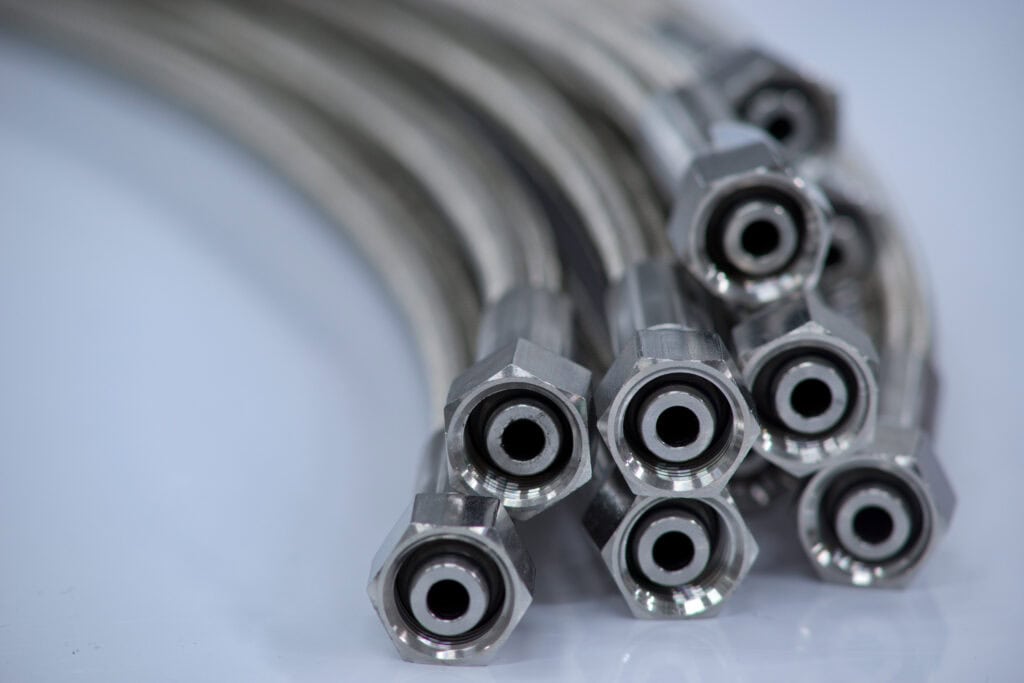
It usually happens at the worst possible time. A hydraulic hose bursts in the middle of a job, oil is everywhere, and now the equipment is down until you can get a replacement. The next question is almost always the same: “How do I measure this thing?” The good news is that measuring a hydraulic hose isn’t difficult if you know what information matters.
What Measurements Do You Need?
There are four pieces of information that are most important when replacing a hydraulic hose:
- Overall hose length
- Hose inside diameter
- Fitting type
- Fitting orientation
If you can identify those four items, you’re well on your way to getting the correct replacement. If you’re unsure about any of them, don’t worry. An experienced hydraulic supplier can often identify the details from the old hose.
How Do You Measure Hydraulic Hose Length?
The first step is determining the hose length. If you still have the original assembly, measure it from one fitting seat to the other, not simply from end to end. Different fitting styles are measured slightly differently, so measuring to the sealing surface provides the most accurate overall length.
Keep in mind that hydraulic hoses are designed with a specific length for a reason. A replacement that’s too short can become overstressed during equipment movement, while one that’s too long may rub against nearby components or create unnecessary bends.
How Do You Determine the Hose Size?
The next step is identifying the hose diameter. Many hydraulic hoses have size information printed directly on the outer cover. If the printing is still legible, it’ll probably list the hose size, pressure rating, manufacturer, and part number.
If the printing has worn away, the inside diameter can be measured after removing the hose, or it can often be identified by the fittings attached to the assembly.
Using the right hose size is just as important as getting the length right. An undersized hose can restrict hydraulic flow, while an oversized hose may not match the system’s design and cause leaks.
How Do You Identify the Fittings?
This is where many replacement projects become more challenging. Two fittings may look almost identical but have completely different thread types or sealing methods. Installing the wrong fitting can result in leaks, damaged threads, or components that simply won’t connect.
The most common hydraulic fitting styles are JIC, ORFS, NPT, and BSPP. If you’re trying to figure out what kind of fitting your system needs, look at:
- Whether the threads are straight or tapered
- The thread diameter
- Thread pitch
- The sealing surface
- Whether an O-ring is present
If you’re unsure, bringing the old hose assembly with you is usually the fastest and most accurate approach.
Why Does Fitting Orientation Matter?
Some hydraulic hoses use straight fittings on both ends. Others have 45-degree or 90-degree elbows that must point in a specific direction. This is known as fitting orientation.
If the angles are incorrect, the hose may twist during installation or fail to route properly around other components. Before removing the old assembly, it can be helpful to take photos of how it is arranged. This will make installation much easier later.
What If You Don’t Know Any of the Measurements?
That’s more common than you might think. Many customers simply bring the old hose to our counter, and we help identify the hose size, fittings, and overall length. If the hose is badly damaged, photos of the equipment or the mating components can also be helpful.
In some cases, especially with older or imported equipment, additional measurements or part identification may be necessary. That’s another reason it’s helpful to work with a supplier that handles hydraulic hose assemblies every day.
Need a Replacement Hydraulic Hose?
If you’ve got a hydraulic hose that’s leaking, worn out, or completely blown, Dewald Fluid Power can help. We stock a wide selection of hydraulic hoses, fittings, and related components, and we build custom hydraulic hose assemblies at our Mishawaka location, often while you wait. Stop by our Mishawaka counter, give us a call, or request a quote to get started.