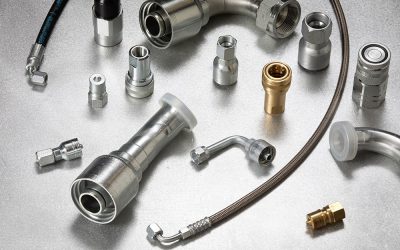
Grab the wrong fitting off the shelf, and you’ll know it fast. Threads that won’t quite seat, a hose that weeps under pressure, or a connection that fails the moment you cycle the system.
The frustrating part is that JIC, ORFS, NPT, and BSPP fittings can look nearly identical at a glance, even though each one seals in a completely different way. Mix them up, and you risk stripped threads, chronic leaks, or downtime you can’t afford.
Once you know what to look for, namely thread angle, taper, and how the seal actually forms, telling them apart gets a lot easier. Here’s a plain-English breakdown of all four, where you’ll find them and how to get the right one the first time.
JIC: The North American Workhorse
JIC (Joint Industry Council) fittings are the connection you’ll run into most often on mobile and industrial equipment in North America. They seal on a 37-degree flare, where the male and female ends meet metal-to-metal as you tighten them, and no thread sealant is needed, since the threads themselves are just there to pull the flare together. That design also makes JIC easy to service: as long as the flare and sealing surfaces aren’t damaged, you can disconnect and reconnect without losing the seal.
You’ll find JIC fittings on agricultural equipment, construction machinery, hydraulic cylinders, and most mobile hydraulic systems.
ORFS: Built for High Pressure and Vibration
ORFS (O-Ring Face Seal) fittings trade the metal flare for an O-ring compressed against a flat face. That small change makes a real difference: the O-ring absorbs minor imperfections and vibration that would eventually work a flare connection loose, which is why ORFS shows up so often on high-pressure circuits and heavy-duty equipment where leak resistance matters more than anything else. If a JIC connection on a piece of equipment keeps needing to be retorqued, ORFS is often the upgrade that solves it for good.
NPT: Tapered Threads, Different Job
NPT (National Pipe Thread) is one of the oldest standards still in everyday use, and it works differently from JIC and ORFS in an important way: the threads themselves create the seal. As a tapered NPT fitting tightens, the threads wedge together, which is why these connections almost always need a thread sealant like PTFE tape. You’ll see NPT on air and water lines and general utility equipment, but it’s not the go-to choice for high-pressure hydraulic hose assemblies that need to come apart and go back together repeatedly.
BSPP: The Import Equipment Standard
BSPP (British Standard Pipe Parallel) fittings turn up most often on European and imported machinery. Unlike NPT, the threads are parallel rather than tapered, and they’re not what creates the seal. That job goes to an O-ring or a bonded sealing washer at the fitting face. Here’s the mistake we see most often at the counter: because BSPP and NPT threads look similar in size, technicians assume they’re interchangeable. They’re not, and forcing the two together is one of the fastest ways to ruin a port.
Identifying the Fitting in Your Hand
If you’re not sure what you’re working with, a few quick checks will narrow it down fast:
- Run a finger or straightedge along the threads: tapered means NPT, straight
- means JIC, ORFS, or BSPP
- Look for a visible 37-degree flare. That’s JIC
- Check for an O-ring sitting against a flat face. That’s ORFS
- Look for a bonded sealing washer. That’s a strong sign of BSPP
- Measure thread diameter and pitch with calipers and a thread gauge for final confirmation
Two fittings that look like they’ll thread together can still have different pitch, angle, or diameter. When in doubt, don’t force it. Forcing mismatched fittings damages threads and sealing surfaces and sets you up for a repeat failure.
Bring Us the Fitting, and We’ll Match It
Fitting identification is something our team at Dewald Fluid Power handles every day, whether it’s a skid steer, a dump trailer, an excavator, or a custom industrial system. We carry the inventory to build a custom hydraulic hose assembly with the exact fitting your equipment needs, and we can source replacement components even when the original isn’t something off the shelf. If you’re not sure what you’re holding, bring the old hose or fitting by our Mishawaka location and we’ll match it on the spot. No guesswork, no forcing the wrong connection into place.